Showing posts with label environmental stewardship. Show all posts

Friday, May 30, 2014

Water stewardship

Interested in harvesting rain? An article in MPRnews, Rain Man: How one Tucson resident harvests the rain, describes the many ways in which Brad Lancaster has developed to make the most of about 12 inches of rain that annual fall in Tucson, Arizona.  Some of the things he does include the following:
  • recycles greywater from his show and washing machine
  • uses a composting commode
  • funnels rainwater into two 1,000-gallon tanks for drinking and irrigation of gardens
  • cut small gaps into street curbs to provide a means for rain water to flow from the street into basins planted with shad trees and native shrubs.
To learn even more about Mr. Lancaster's approach to conserving water you might check out his book "Rainwater Harvesting for Drylands."

Saturday, October 27, 2012

No presidential debate about global climate change

Have you noticed how silent both the president of the United States, Barack Obama, and his challenger, Mitt Romney, are on the topic of global climate change?  Seems they're eager to promote big oil, gas and coal, but are talking very little about conservation.

An article in the Bloomberg News, "Romney, Obama avoid climate change stigma, waste air" discusses this omission. It would appear that their big political contributors are making their individual and corporate profits through maintaining the status quo.  This is at odds with the interest of the earth and hence, the health and vitality of future generations.

Besides solar and wind power, some of the environmental matters that should be discussed include increased construction of green buildings (more efficient architecture), mass transit and increased urban and suburban housing density.

Thursday, October 18, 2012

What was missing in the presidential debates

Sojourners, a Christian social justice organization, noted the following important issues have been missing from the presidential debates:
  • Poverty: To spark conversation about poverty during election season, Sojourners just released a documentary called The Line, which highlights stories from 4 people living under the poverty line.

  • Stewardship of God’s creation: Scientists are now starting to connect the dots between severe weather events and global climate change. This should be a top issue for our next president. We believe that as Christians we’re called to protect clean air and water and work toward a renewable energy future. 

  • Elimination of nuclear weapons: The staggering counts of nuclear warheads in our world aren’t in line with Christian values of peace and restraint of violence. The candidates ought to support peace – in Afghanistan by ending drone attacks and globally by using international law to counter terrorism. 

  • Get money out of politics: One person equals one vote – buying elections is immoral. 
Throughout the debates it seems that painting the other candidate as weak, and blaming them for there past record has more important than looking toward the future and sharing a vision that will benefit the earth and all of its citizens. While I'm wishing for things, wouldn't it be nice if they could be civil too?
"Speak out.  Judge righteously. Defend the poor."   (Proverbs 31:9)

Tuesday, February 7, 2012

Hooray for the USA, we're eating less meat!

Piglets at Minnesota State Fair
A report on National Public Radio noted that citizens of the USA are eating 12 percent less meat than we were five years ago.  That said, we shouldn't boast too much about this trend, since Americans still eat about one-sixth of the total meat consumed in the world, despite that we're only one-twentieth of the population.

Why celebrate this reduction in meat eating? The environmental impact of meat production is tremendous. It is estimated that the meat industry contributes about 18 percent of global greenhouse-gas emissions.  Methane and Nitrous Oxide, byproducts of meat production. have many times the global-warming potential than Carbon Dioxide.  Another environmental concern is land degradation in the 30 percent of the world's land set aside for raising livestock.  Finally, the amount of water needed to feed animals is greater than to simply grow grains, vegetables, legumes and fruits.
Cows grazing on farm near
Lanesboro, Minnesota

Because of the high environmental costs of raising livestock it is thought that this sector is one of the top two or three contributors to our local and global environmental concerns. Hence, it is good for the environment when we eat lower on the food chain.  And, it is often better for our health too!

As our meat consumption declines I'm eager to watch a commercial from a national restaurant chain with the punch line of "Where's the tofu?"

Wednesday, June 22, 2011

Oceans degrading more rapidly than anticipated


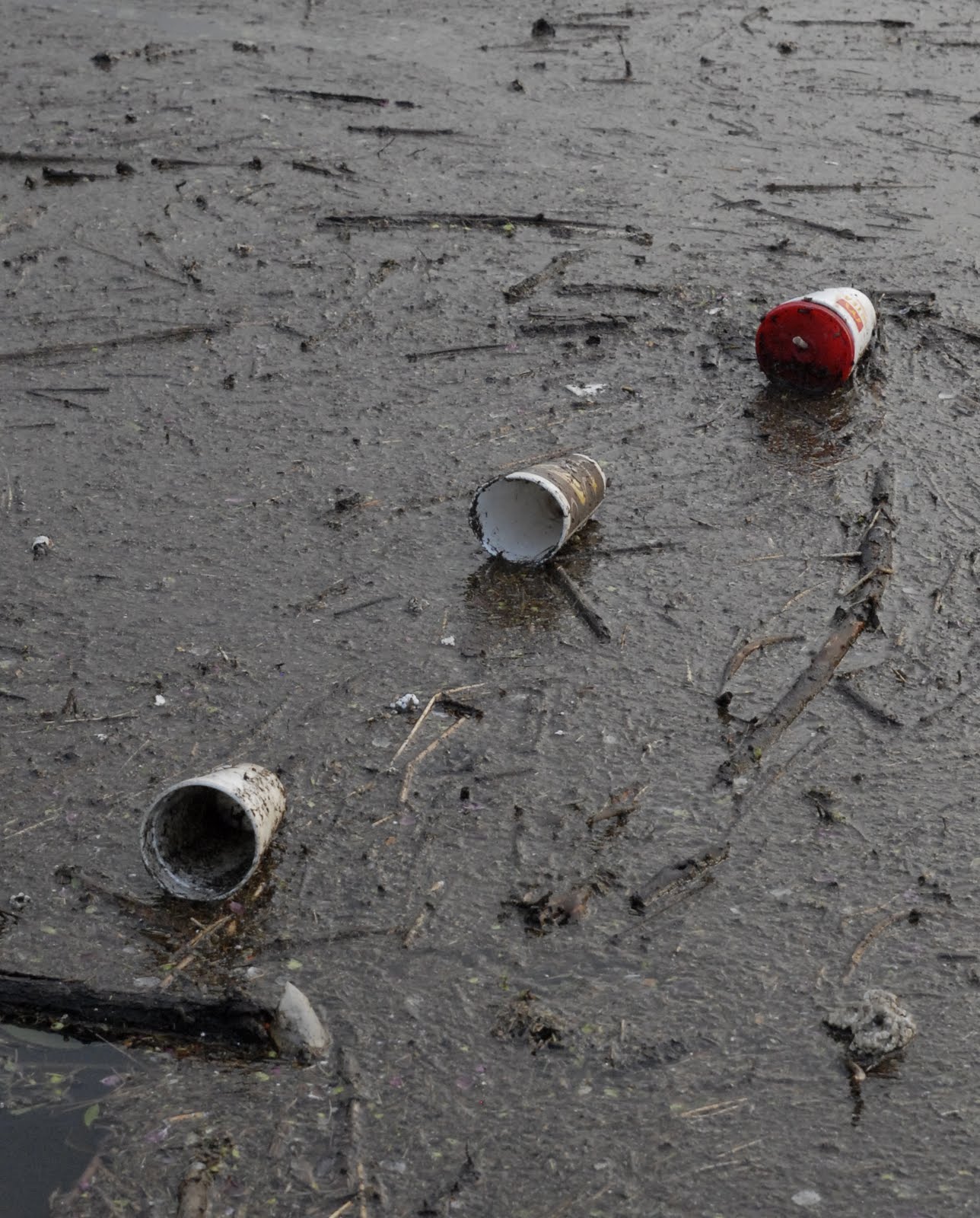
Styrofoam cups floating in pond
What's really big news? The headline in today's Star Tribune was regarding the start of the trail of young man who killed a couple of people.  If it bleeds it leads. If you dig more deeply, a column on page A6, contains an article "Scientist warn that oceans are on brink".  The article is brief enough that I've copied it below.

While sensational local news tends to grab our attention, let's not take our eyes of the larger, more global picture.  All of us depend upon the health of the world's oceans, even those of us that live over a thousand miles away from the nearest ocean.  Everything in nature is linked together in the web of life.  The way that I treat my yard impacts the run off into the nearby pond, then stream, then river, and finally the ocean.  All the stuff that I buy often involves considerable production costs, not the least of which is paid by the environment.  Every time I drive my car it has a huge environmental impact. It still rings true, think globally and act locally.  Let's be the change that we want to see in the world.
Cleaning up around pond


WORLDWIDE

Scientists warn that oceans are on brink
The world's oceans are degenerating far faster than predicted and marine life is facing extinction due to a range of human impacts -- from overfishing to climate change -- a report compiled by international scientists warned. The cumulative effect of "severe individual stresses," ranging from climate warming and sea-water acidification to widespread chemical pollution and overfishing, would threaten the marine environment with a catastrophe "unprecedented in human history." The conclusions were published by a panel of international scientists who reviewed recent research at a workshop at Oxford University in Britain. They will be presented to the United Nations this week.

Thursday, June 9, 2011

Earth showing clear signs of unrest

Tornado damage to North Minneapolis 
A tongue in cheek article "Planet Earth Doesn't Know How To Make It Any Clearer It Wants Everyone To Leave" in The Onion newspaper cuts a little close to home.  The catastrophic occurrences just within the month of May were cause for the following headline article in the Wall Street Journal, May Storms Caused Up to $7 Billion in Insured Losses.  Climate change has my attention, and I hope it has yours too.  
     You and I can't change the vast amounts of toxins that are being dumped into the air, land and water by others at home or abroad.  We can however "be the change", by working on those things within our circle of influence e.g. our transportation habits, consumption of things, conservation of resources, etc. 
    We can also become advocates for the environment with our friends, relatives and political leaders.  When we see wasteful corporate/business behavior we can talk to the management and write letters. 
    We had better all soon start taking better care of our environment, because there just aren't a lot of other human friendly planets nearby.  Were we to find a hospitable planet to invade it would also get a bit crowded for 7 billion earthings in the soon to be retired Space Shuttle.

Tuesday, January 4, 2011

Panda dung made into sculpture

I delighted to read an article in the LA Times about a sculpture made entirely of Panda dung of Venus De Milo.  The artist, Chinese sculptor Zhu Cheng, used dung in sensitivity to the environment (its biodegradable, right?). She also incorporated a dozen young helpers who weren't afraid to get their hands dirty.  Up next for artist Cheng and her young friends is a full sized sculpture of Michelangelo's David.

Eco sole in snow
 This environmental art reminds me of the Tibetan Buddhists that create beautiful mandala sand painting, which they destroy shortly after completion. They destroy their creations to highlight the temporal nature of things. Many indigenous peoples create such ecologically friendly art. They don't seem to have permanence as a primary aspiration for their artistic endeavours.

At left is my artistic effort with the natural elements.  It is a picture of my footprint in the morning snow.  Like the snow, the print is temporal in nature.  Thanks to digital photography, the image is only electronic. 

As I get nearer to my expiration date on this planet I'm thinking more of how I can leave less waste behind.  This includes everything from plastic bags and Styrofoam cups to used automobiles and electronics.  I shudder to think of the huge pile of waste that I've created living in the USA, with our vast material abundance. As one who has been a reasonably good American consumer, sadly the creation of much trash has been a part of my legacy.

So it is that I can appreciate the creation of art out of Panda bear dung. I'm pleased to report that it also brought the artist $50,000.  Environmental stewardship pays!